

Updated on 4 August 2026
Almost every comparison of channel managers is written by one of the vendors, and most of them publish no prices. This one publishes the entry price of all seven, including the two vendors who do not advertise one and the two whose headline figure is not what you will actually pay.
The seven all sell into Europe and all serve properties in the small-to-mid range. SiteMinder and Cloudbeds are excluded because they target larger hotels. Hostaway and OwnerRez are excluded because they are North America first.
The short version
- Octorate connects 160+ channels, the widest stated coverage here. Amenitiz reports 150+, Smoobu 100+, Guesty 60+, Lodgify 7 direct APIs.
- From €8 per room per month, published openly. Two of the seven publish nothing at any tier.
- No commission on bookings. Smoobu takes 0.9% on its entry plan, Guesty Lite takes 1%.
- No minimum spend. Avantio charges €295 a month until you reach twenty properties.
- The decision that matters most is not price. It is whether you are charged per room or per unit.

The comparison
| Tool | Entry price | Charged by | Booking fee | Trial | Channels |
|---|---|---|---|---|---|
| Octorate | from €8 | per room | None | 14 days | 160+ |
| Guesty Lite | from $9 | per listing | 1% | 14 days | 60+ |
| Smoobu | €29 | per unit | 0.9% | 14 days | 100+ |
| Lodgify | $14 | per property | None | 7 days | 7 direct |
| Amenitiz | not published | per room | None | none | 150+ |
| Avantio | €295 min. | per property | None | none | 50+ |
| AvaiBook | not published | per property | None | not stated | not stated |
Taken from each vendor’s official pricing page on 4 August 2026. Channel counts are self-reported and not measured the same way. Some count OTAs, some count partners, some count direct API connections. The Octorate figure is reported on the same basis as the rest.
How the ranking was made
Four criteria, applied to all seven in the same way. How many channels the vendor connects. Whether a price is published at all. Whether anything is deducted per booking. And how the charging model fits the inventory you are actually selling.
On the first three, Octorate comes out ahead of this group. 160+ channels and partners is the widest stated count here. €8 per room per month sits on the pricing page, while two of the seven publish nothing at any tier and a third publishes €14 before applying a €295 floor. And nothing is deducted per booking, where two tools charge a commission on precisely the plan a small property starts on.
The fourth criterion has no single winner, and it is the one that decides most cases. Per-room pricing suits rooms. It is the wrong shape for a single apartment.
So the ranking is not the same for everyone. For one apartment with its own website, Lodgify is cheaper and quicker to set up. Above roughly 200 units with an operations team, Guesty Pro has depth the rest of this list does not attempt. Both are said plainly in the entries below.
The pricing model: rooms or units
Channel managers grew out of two different businesses, and they still price like it.
Tools built for vacation rentals charge per unit, per listing or per property. One apartment, one fee. That is clean when your inventory is separate flats in separate buildings.
Tools built for accommodation with several rooms under one roof charge per room. Octorate and Amenitiz work this way.
Take a twelve-room guesthouse. On Octorate that is €96 a month, and every room is a sellable unit with its own rates and restrictions across all connected channels. On a per-unit tool the property may count as a single listing, which looks cheaper until you find out how many rate plans that listing can carry, and you are moved onto a portfolio tier that was never priced for a property your size. Avantio removes the ambiguity entirely: below twenty properties you pay €295 a month whatever your size.
This is the most expensive mistake we see people make when choosing, which is why the charging model sits next to the price in the table above rather than in a footnote.
Guesty Lite, “from $9”. That is the pay-as-you-grow plan, which adds 1% of every booking. On a listing turning over €3,000 a month that is €30 more, so the real figure is nearer $39. Guesty’s flat plans start at $20 per listing annually and $29 monthly.
Smoobu, “€29”. This plan carries a 0.9% booking fee. The zero-fee plan costs €31.50, and for most hosts it works out cheaper overall.
The seven, one by one
1. Octorate
Best overall
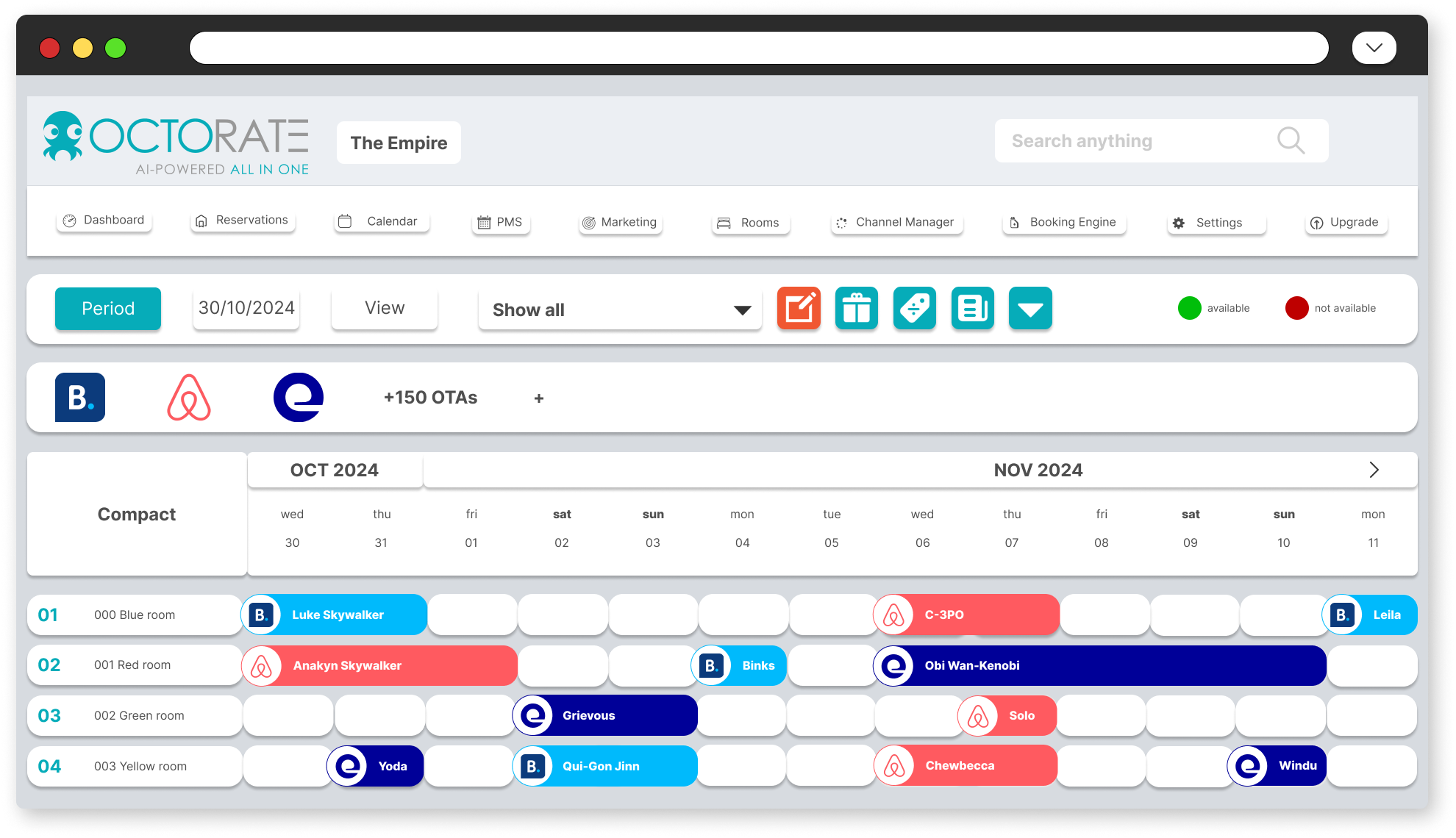
- Every property type: hotels, B&Bs, guesthouses, aparthotels, hostels, campsites, apartments and mixed portfolios.
- Channel manager, PMS, booking engine, website builder, payments, self check-in, unified inbox, owner portal and rate checker in one subscription rather than seven.
- Per-room pricing, so a twelve-room property is priced as twelve sellable rooms instead of one listing.
- No commission on bookings and no minimum spend.
- An AI assistant that works across the whole suite, not one function. Ask in plain language about reservations, availability, rates, reports or guest messages, and the answer is built from live PMS, channel manager, booking engine and inbox data.
- Open API and an MCP server, so outside AI assistants reach the same data through a structured interface.
- Certified connectivity partner of the major OTAs for over ten years.
The AI part of this comparison works on two levels, and Octorate is on both.
Inside the product, the assistant reads only what each user is authorised to see, answers from updated data across all four modules, and stops before acting. When an action is required, a person confirms it and the operation is logged. That scope comes directly from being one system rather than several: an assistant can only answer across reservations, rates, channels and messages if those things live in the same place.
Outside the product, the Model Context Protocol (MCP) is the open standard that lets an assistant such as ChatGPT or Claude connect to a system directly. Ask it about tonight’s occupancy or an unanswered message and the answer comes from live data instead of a dashboard export, inside the permissions you set.
The limitation: only the Basic tier carries a public price. Pro and Ultimate are quote-based, the same as Amenitiz.
2. Guesty
Best for large portfolios
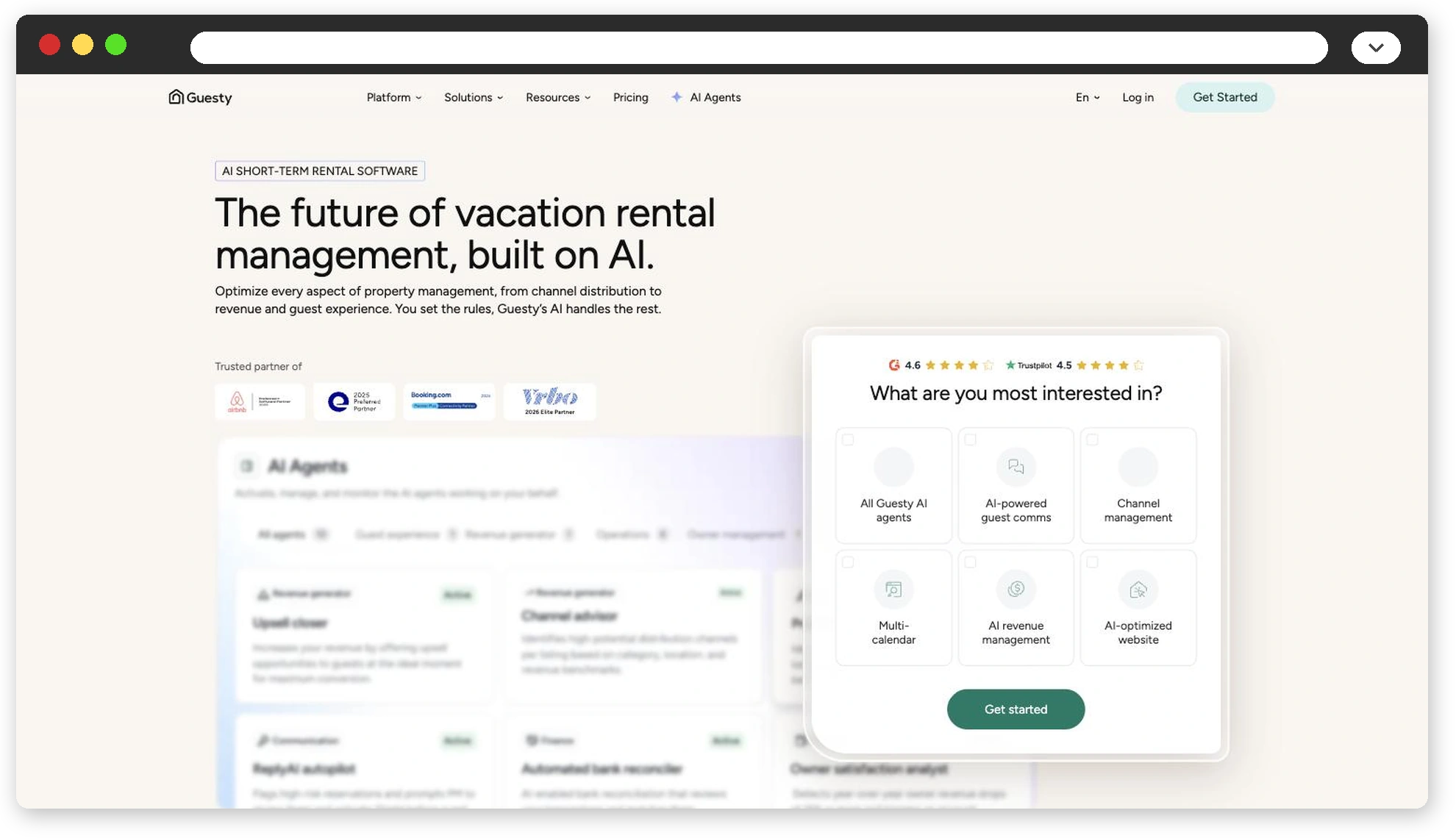
- The $9 headline carries 1% of every booking. Flat pricing starts at $20 per listing.
- 60+ channels, the second narrowest count in this comparison.
- Some connections are routed through other channel managers rather than made directly. Guesty lists SiteMinder and Rentals United among its integrations.
- Guesty acquired Rentals United in 2024, so two of the comparison sites you will meet on this search belong to the same company.
- Three separate products under one name. Moving between Lite, Pro and Enterprise is a migration, not an upgrade.
The most established name on this list, with more than 500,000 listings on the platform, and the vendor here that has committed hardest to AI. Its homepage now leads on it, and it sells a set of agents that each handle one job, among them upselling, channel advice, guest replies and bank reconciliation. At 200 listings and above, with an operations team, Guesty Pro has operational depth that most tools here do not attempt.
Below that threshold the pricing works against you, and the channel count is a real constraint if your bookings come from anywhere beyond the largest OTAs.
3. Smoobu
Good for one or two apartments
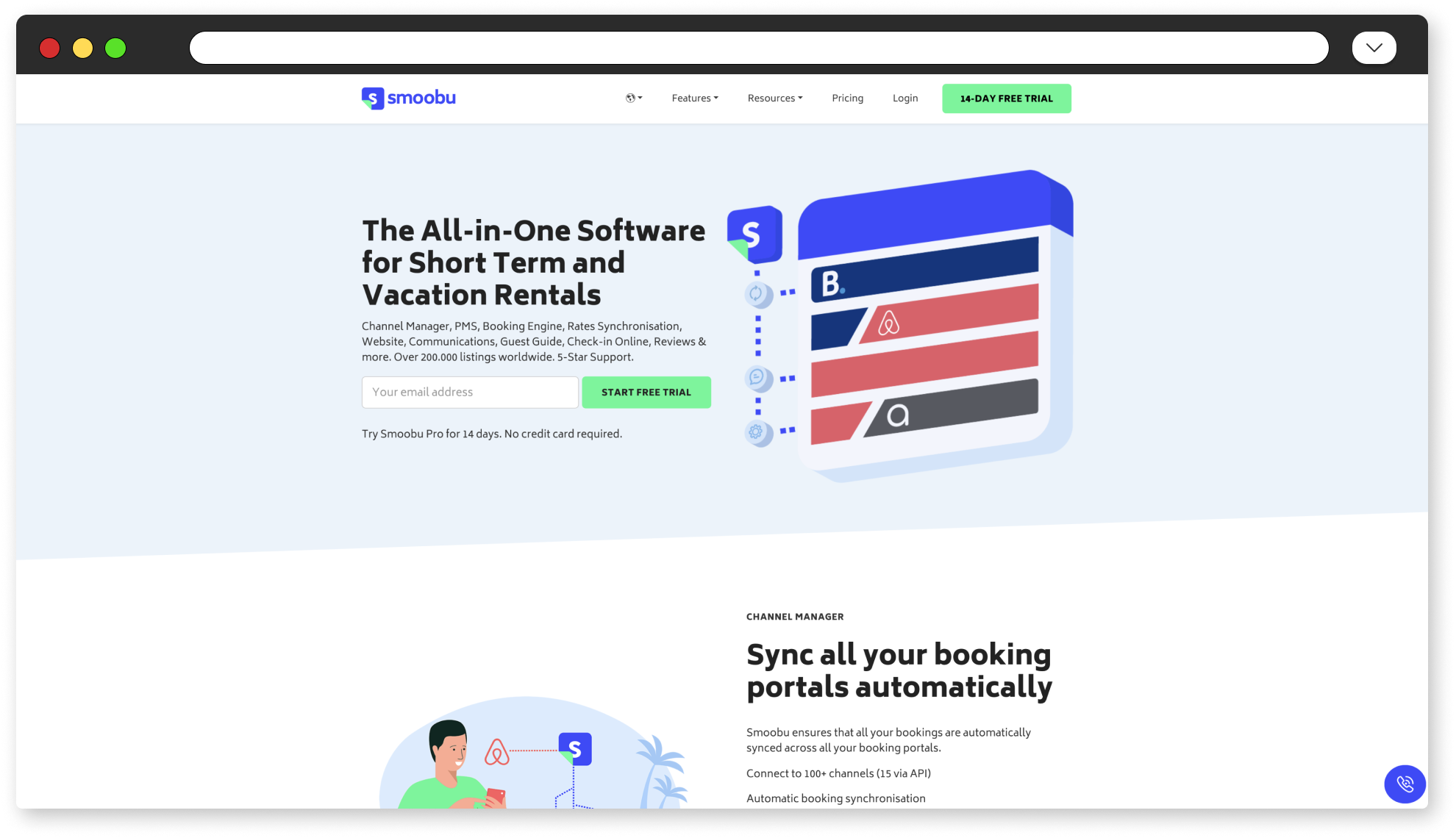
- Priced per unit. A building with several bookable rooms multiplies quickly.
- The €29 entry plan takes 0.9% of every booking. The zero-fee plan costs €31.50.
- Additional units from €9.60 a month. Above twenty properties it moves to a custom quote.
- Built for hosts rather than hotel operations. No room-level rate strategy.
Genuinely easy to set up, and for one or two apartments that counts for a lot. Once your inventory is rooms in one building rather than separate flats, the pricing model starts working against you.
4. Lodgify
Good for a single rental with its own site
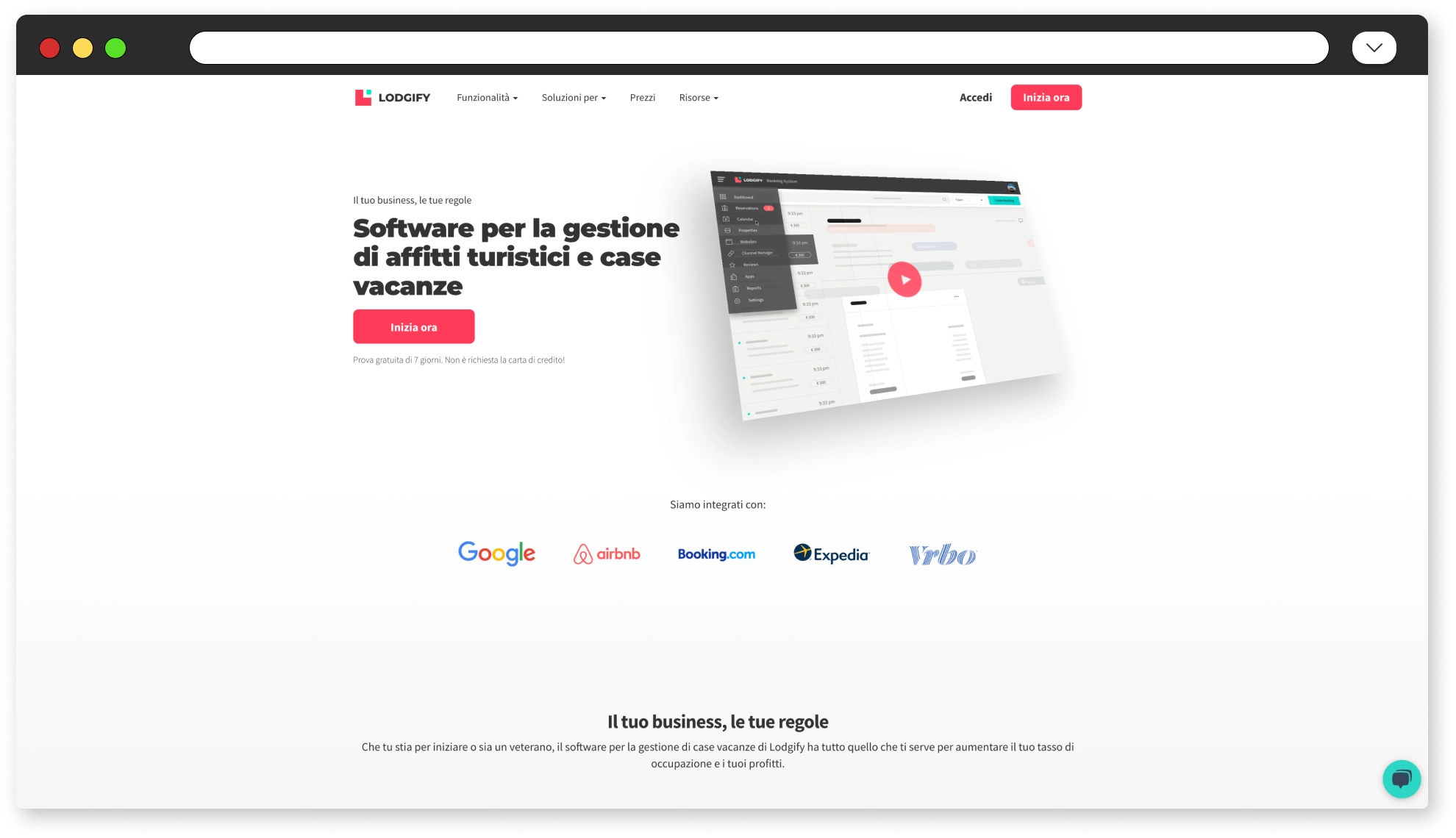
- Seven direct API connections: Airbnb, Vrbo, Booking.com, Google Vacation Rentals, Expedia, Abritel and FeWo-direkt. Everything else runs on iCal.
- iCal syncs availability only. Not rates, not restrictions, and not in real time.
- A 7-day trial, the shortest here.
- Priced per property, with plan-level caps on how many you can hold.
The website builder is the reason people choose it, and for one rental selling on the largest OTAs it is the cheapest complete answer on this list. The gap between 7 connections and 160 is the trade you are making.
5. Amenitiz
Good for small hotels in France and Spain
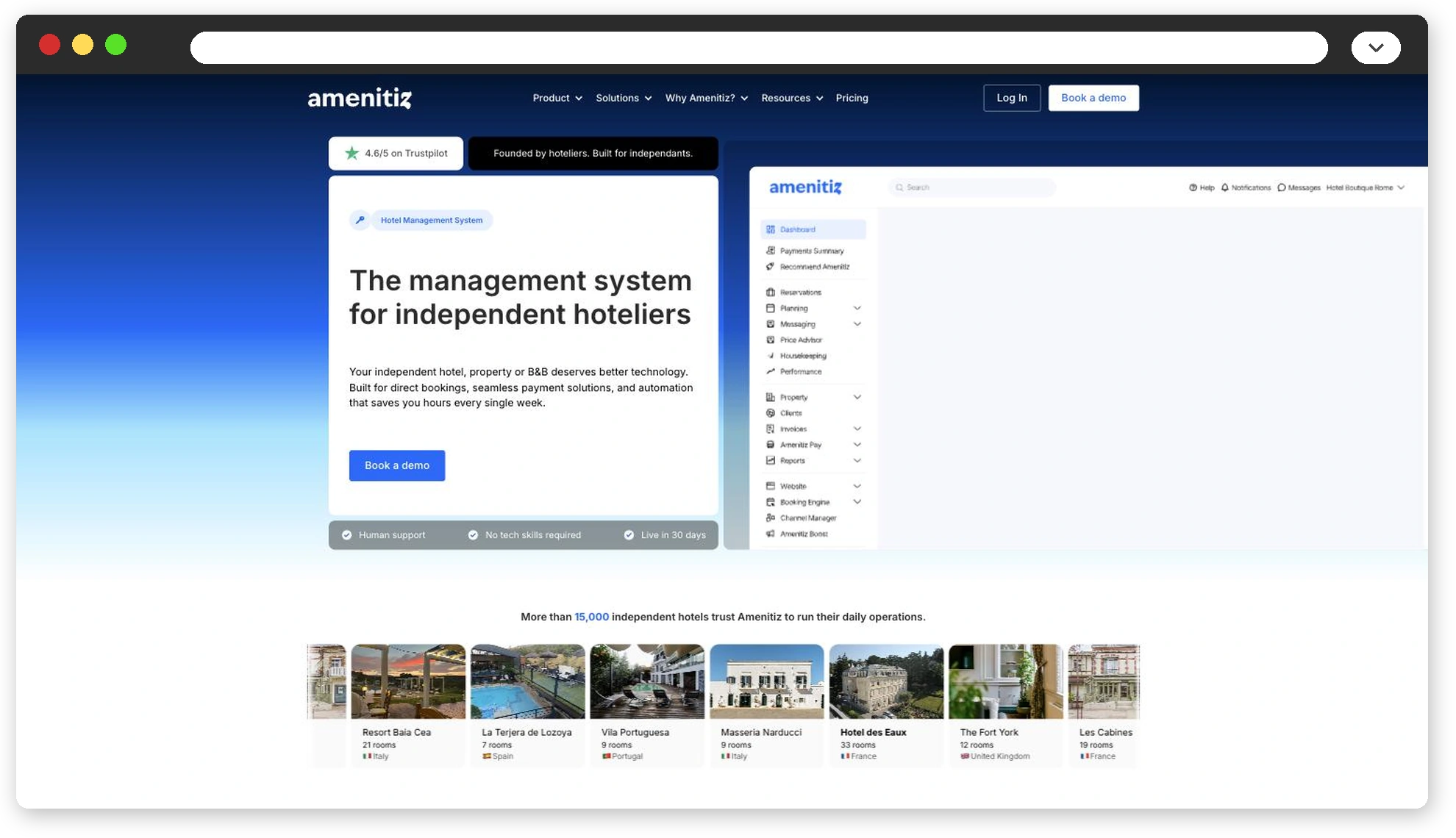
- No public price on any of the five plans. Budgeting means a sales call.
- No free trial. The offer is “live in 30 days or your first month is free”.
- AmenitizPay adds 1.5% plus €0.25 per transaction on top of the subscription.
- Built for independent hotels of roughly 3 to 30 rooms. Apartments and mixed portfolios are not its natural ground.
- Support rated 3.9 out of 5 by users on Hotel Tech Report.
The closest competitor to Octorate on model, since it also prices by room. It raised $45 million in November 2025 and moves quickly. The difference on day one is that we publish a starting price and give you fourteen days to try the product.
6. Avantio
Good for property managers above 20 units
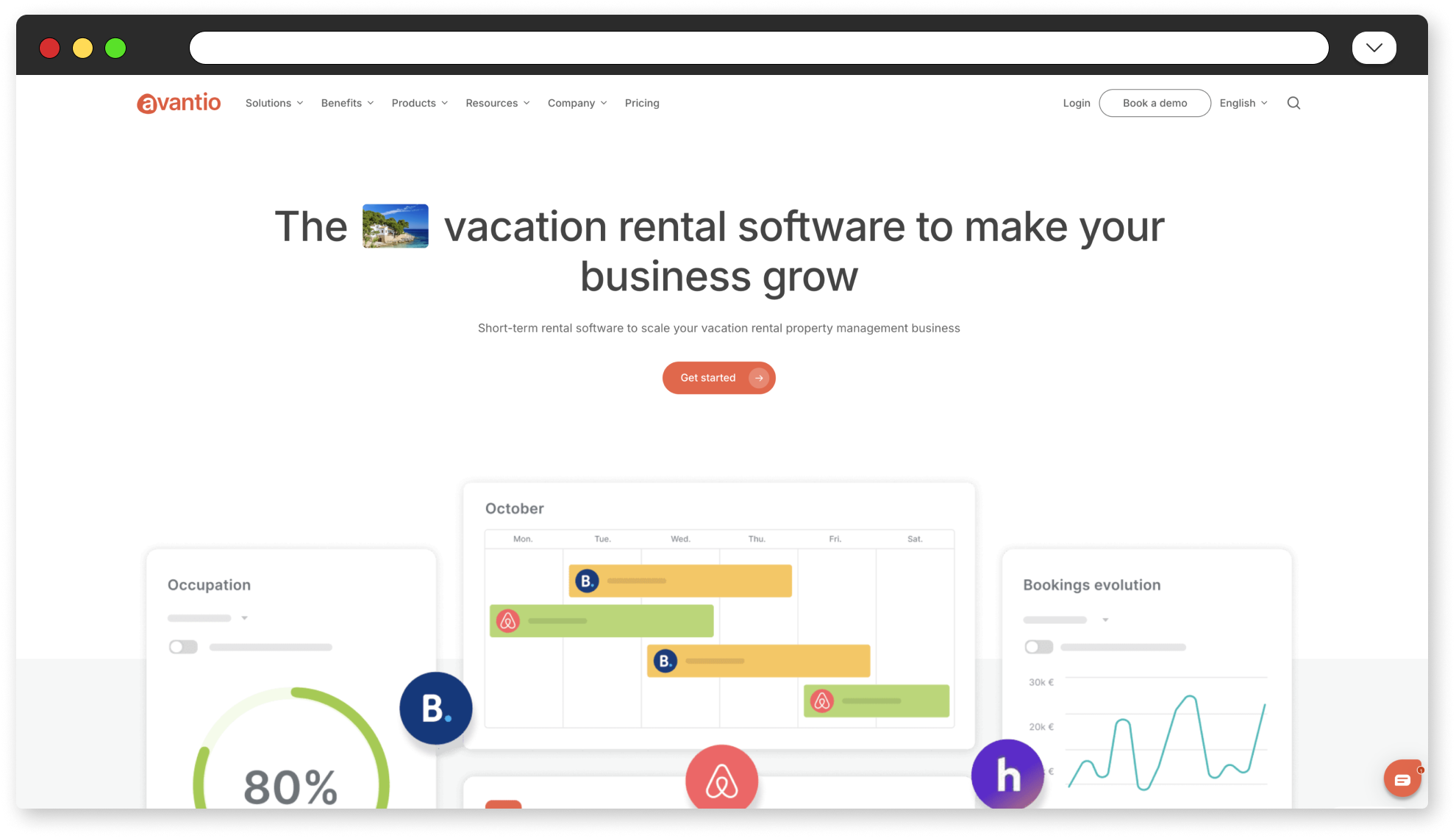
- The €14 headline only applies past twenty properties. With five you pay €59 each.
- No free trial. Demo only.
- 50+ channels, the narrowest stated count apart from Lodgify.
- Avantio states its software “works best alongside a portfolio of 20+ properties”. The pricing is designed to exclude smaller operators.
For an established agency with a real portfolio it is a serious tool with no booking commissions. Below twenty units the arithmetic does not work.
7. AvaiBook by idealista
Good for the Spanish market
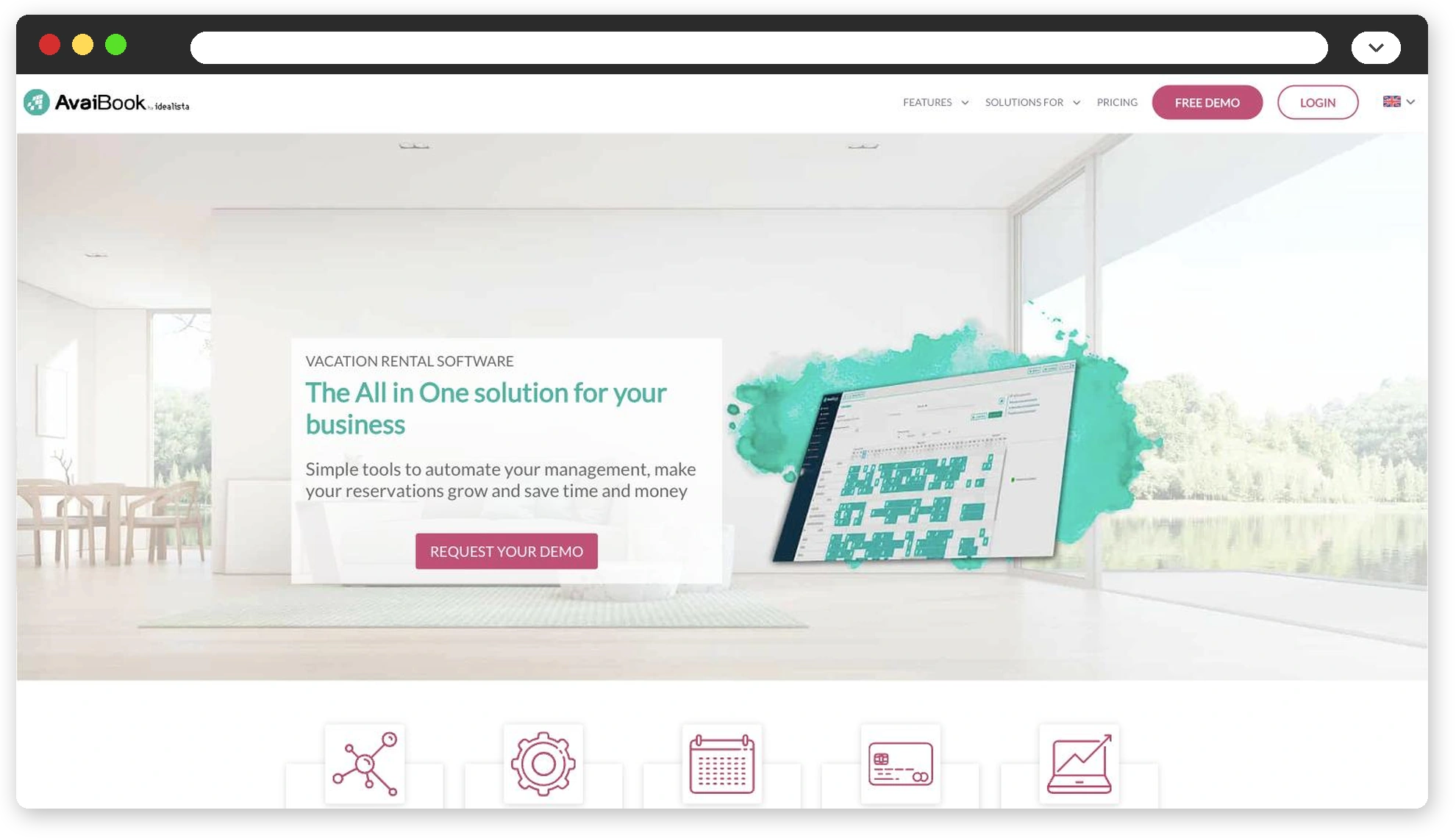
- The pricing page shows placeholders instead of figures. The real number appears only inside your account.
- No total channel count published anywhere.
- Card processing charged separately: 2% on SEPA cards, 4% outside SEPA and on Amex, virtual and B2B cards.
- Distribution strength comes from idealista in Spain and does not transfer to other markets.
If you operate in Spain and value the idealista connection, it earns a place on the shortlist. Outside Spain the advantage disappears and the missing information starts to matter.
Fourteen days, your real rates, your real channels
Connect your rooms, load your rates, watch the sync run. No card, no commitment, and a starting price you can read before you talk to anyone.
What actually separates them
Every tool on this list will keep two calendars from clashing. That is the floor, not the product. Five things separate one from another once you are past the demo, and none of them appear on a pricing page.
Two-way sync, not calendar blocking
A real connection pushes availability, rates and restrictions out to the channel and pulls reservations, modifications and cancellations back, in near real time. A weak connection blocks dates and stops there. The difference shows up the first time you change a minimum stay in one place and find it did not travel. Ask any vendor which specific channels are connected by direct API and which run on iCal, because the answer varies inside the same product.
Which channels, not how many
A count of 160 is only useful if your guests are on those channels. A German property selling through FeWo-direkt and HomeToGo needs two specific connections, not a long list. Take your last twelve months of bookings, list the sources in order of revenue, and check that list against the vendor. Anything past the top six or seven rarely moves the number.
Whether your rate strategy survives
Most tools sync a price. Fewer sync the structure around it: derived rates, occupancy-based pricing, length-of-stay rules, channel-specific markups, restrictions that differ by day of week. If you run one rate and one room type this does not matter. If you run four room types with derived rates and a weekend policy, this is where cheap tools stop working and you find out after migration rather than before.
What happens when a sync fails
Connections break. OTAs change their APIs, credentials expire, a rate plan gets deleted at the channel end. The question is not whether it happens but whether you find out from the system or from an angry guest. Ask what the vendor does when a push fails: is there an alert, a retry, a log you can read, and a human who answers when it is your busiest weekend. Support response times are worth more than a feature list, and they are the single most common subject of negative reviews across this category.
What is bundled and what is extra
The subscription is rarely the whole cost. Payment processing is charged separately almost everywhere, at rates that differ by card type and region. Onboarding may be included, discounted or billed. Some plans cap the number of rate plans, users or properties in ways that only surface once you are inside. Add the processing fee to the subscription before comparing anything, because on a property taking €10,000 a month it is usually the larger of the two numbers.
How to choose, in three questions
1. Are you selling rooms or units?
Rooms in one building point to Octorate or Amenitiz. Separate apartments point to Smoobu, Lodgify, Guesty or Avantio. Get this wrong and you pay for capacity you cannot use, or hit a ceiling nobody mentioned.
2. How many, and how fast are you growing?
One or two apartments: Lodgify or Smoobu. Rooms in one property, at any size: Octorate. Two hundred units with an operations team: Guesty Pro. The band where most tools disappoint is five to fifteen rooms, which is exactly where per-room pricing earns back the difference.
3. One system or several?
A channel manager on its own keeps availability and rates in sync. It will not take a direct booking, hold a card or run a stay. Buy those separately and you pay more and maintain more integrations. Every tool here bundles at least a PMS and a booking engine, and the depth is where they diverge.
What changed in 2025 and 2026
Channel management is being absorbed into the PMS. In May 2026 Mews and SiteMinder launched a native integration, putting distribution inside the PMS rather than beside it. If the category is collapsing into one layer, buying a standalone channel manager deserves a second look. It is also why Octorate has been all-in-one from the start.
AI arrived on three separate fronts, and they get confused with each other.
The first is AI aimed at one job at a time. Guesty has gone furthest here. It started with a revenue management agent in December 2025 and now sells a family of them, each with a defined task, covering pricing, upselling, channel advice, guest replies and bank reconciliation. You switch them on one by one and watch what each does. That is real work taken off the desk. It is also several separate tools rather than one.
The second is AI as a way of being found. Lodgify announced a pilot connecting listings to ChatGPT, so a traveller describing the stay they want can be matched to a property and sent to a booking page. That is a marketing channel, not an operational tool.
The third is an assistant that works across the whole operation, and it is only possible where the operation is one system. Octorate’s assistant answers from reservations, rates, channels and the guest inbox together, reads only what the user is authorised to see, and asks for confirmation before it acts. Alongside it sits an MCP server, the open standard that lets an outside assistant such as ChatGPT or Claude reach the same data through a structured interface.
None of these is finished, and anyone claiming otherwise is selling. But they are different bets. Two of them add a feature. The third changes how the day runs.
Money moved into the European mid-market. Amenitiz raised $45 million in November 2025 to serve independent hotels in Europe. Expect faster releases and sharper pricing in that segment.
If you rent in the EU, registration numbers are now your channel manager’s problem
Regulation (EU) 2024/1028 has applied since 20 May 2026. Short-term rental hosts must register the property with national authorities, obtain a unique registration number and display it in every listing. Platforms have to check that the number is present, refuse listings without one, and report booking data monthly. Hotels are out of scope.
The number has to reach every channel, correctly, and stay there. Across several properties and several OTAs that is exactly the repetitive field that gets missed on one listing and takes it offline. Ask any vendor you are evaluating how they handle it. Not all of them have an answer yet.
Frequently asked questions
For properties selling rooms, meaning hotels, B&Bs, guesthouses and aparthotels, Octorate ranks first here on the widest stated channel coverage (160+), per-room pricing from €8 and no booking commission. For a single apartment with its own website, Lodgify at $14 a month. For portfolios above 200 units, Guesty Pro.
Guesty Lite advertises the lowest entry price at $9 per listing per month, but adds 1% of every booking. The cheapest flat rate with no booking fee is Lodgify at $14 per month on annual billing, for one property. For a property with several rooms, Octorate at €8 per room is usually lower in total. Prices checked 4 August 2026.
Most do not. Smoobu takes 0.9% and Guesty Lite takes 1% on their entry plans, and both sell flat alternatives. Octorate, Lodgify, Avantio and AvaiBook charge no booking commission. This is separate from what the OTAs themselves take, which is a much larger number: see our breakdown of Booking.com fees and Airbnb service fees.
Of the seven compared here, Octorate states the widest coverage at 160+ channels and partners, ahead of Amenitiz (150+), Smoobu (100+), Guesty (60+), Avantio (50+) and Lodgify (7 direct API connections). All counts are self-reported by each vendor.
Three of the seven have announced something. Octorate has an assistant that works across reservations, rates, channels and the guest inbox, scoped to each user’s permissions and requiring confirmation before it acts, plus an MCP server for outside assistants. Guesty sells a family of single-purpose agents covering pricing, upselling, channel advice, guest replies and bank reconciliation, activated and monitored one by one. Lodgify announced a pilot connecting listings to ChatGPT, which is a way of being found rather than a way of operating.
Through MCP, the Model Context Protocol, yes. It is the open standard that lets an outside assistant read live reservations, availability, rates and messages from a system and act on them, within permissions the property sets. Of the seven compared here, Octorate publishes an API and an MCP server.
No. A channel manager syncs availability and rates across OTAs. A PMS runs the property: reservations, guests, invoicing, housekeeping. All seven tools here bundle both, though standalone channel managers do exist.
An API connection syncs availability, rates and restrictions in near real time, in both directions. iCal syncs availability only, on a polling schedule that can lag by hours. Beyond blocking a calendar, iCal is not enough.
Yes, but plan it outside peak season. Existing reservations stay in the OTA extranets. The risk sits in the overlap period when two systems hold the same inventory, which is where overbooking happens. Octorate runs the migration with you and connects your channels before anything is switched off.
- Vendor pricing pages consulted 4 August 2026: octorate.com, smoobu.com, guesty.com, lodgify.com, amenitiz.com, avantio.com, avaibook.com
- Regulation (EU) 2024/1028 on data collection and sharing for short-term accommodation rental services, applicable from 20 May 2026
- Model Context Protocol specification
- Mews and SiteMinder native integration announcement, 27 May 2026
- Guesty AI agents range, homepage consulted 4 August 2026; revenue management agent announced December 2025
- Lodgify brand and product announcement including ChatGPT pilot, 13 May 2026
- Amenitiz $45M Series B announcement, 11 November 2025
- Guesty acquisition of Rentals United, May 2024